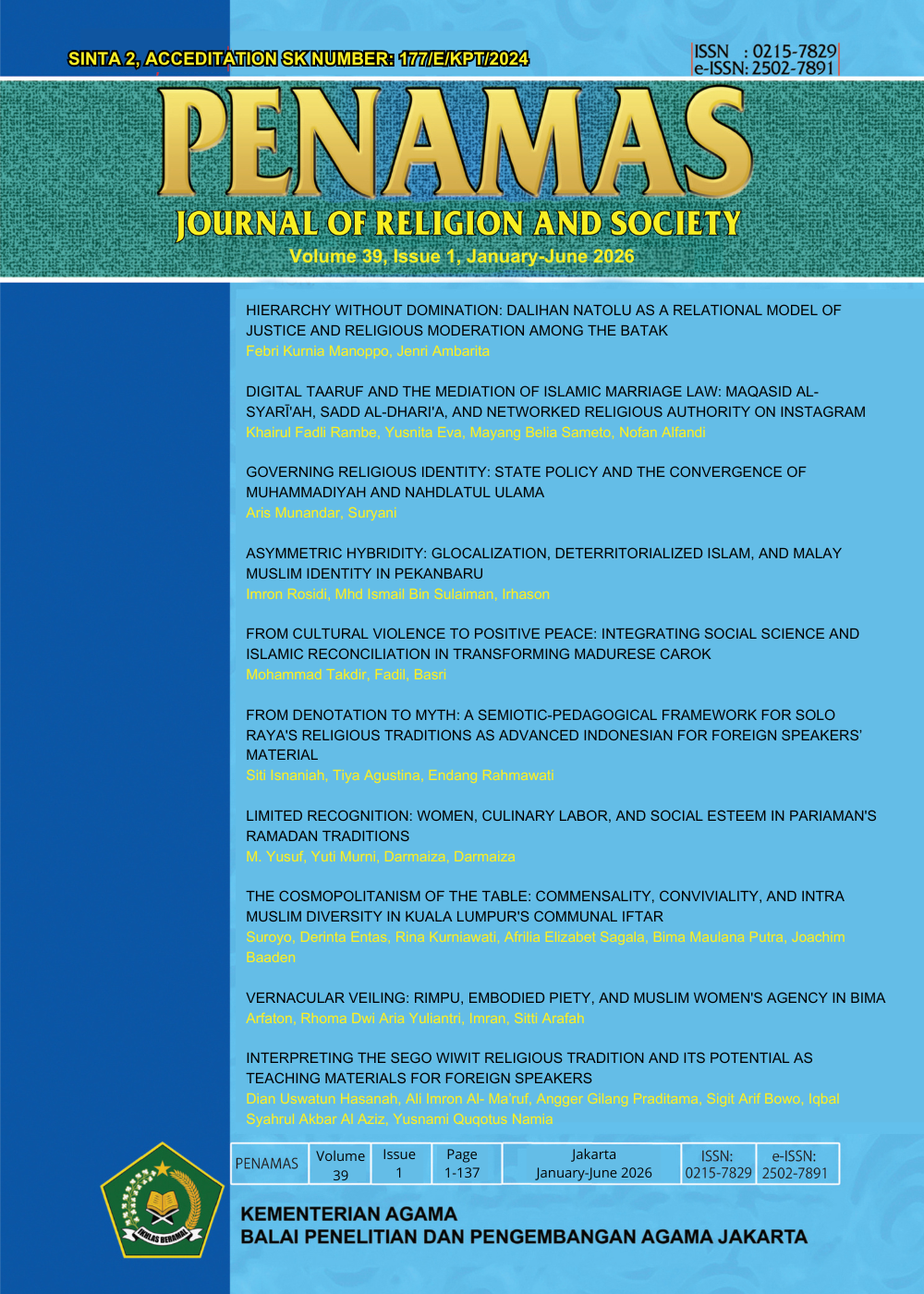
Asymmetric Hybridity: Glocalization, Deterritorialized Islam, and Malay Muslim Identity in Pekanbaru
DOI:
https://doi.org/10.31330/penamas.v39i1.1046Keywords:
Globalization, Malay Muslim Identity, Deterritorialization of Islam, Re-Islamization, GlocalizationAbstract
The Riau Malay people, who are identified as Muslims, have not been immune to the wave of contemporary globalisation that is shaping their way of life. This article examines the construction of Muslim Malay identity in Pekanbaru, exploring how transnational flows of Islamic knowledge interact with local Malay traditions and Indonesian national culture. This qualitative study is based on interviews and observation, analysed through the lenses of glocalisation (Robertson), global cultural flows (Appadurai) and the deterritorialisation of Islam (Roy), alongside literature on the ‘conservative turn’ in Indonesian Islam. The findings reveal a paradox: globalisation gives rise to a hybrid identity comprising local Malay, national Indonesian and transnational Islamic elements, whilst simultaneously intensifying Islamic identity as social media da’wah and religious activities in public spaces expand. This hybridity is asymmetrical—the religious layer is on the rise and becoming increasingly deterritorialised, whilst Malay elements persist as residual markers rather than organising centres—indicating a deterritorialised re-Islamisation: Islam is detached from local customs and re-anchored within a standardised transnational register.
References
Andaya, L. Y. (2008). Leaves of the same tree: Trade and ethnicity in the Straits of Melaka. University of Hawaii Press.
Asteriani, F., & AR, H. F. (2025). FILOSOFI RUMAH ADAT MELAYU: REPRESENTASI PERADABAN ISLAM. Journal of Urban Regional Planning and Sustainable Environment, 4(02).
Bauman, Z. (2001). Identity in the globalising world. Social Anthropology, 9(2), 121–129.
Bhabha, H. K. (2012). The location of culture. routledge.
Bowen, G. A. (2009). Document analysis as a qualitative research method. Qualitative Research Journal, 9(2), 27–40.
Effendy, T. (2004). Tunjuk ajar dalam pantun Melayu. Balai Kajian dan Pengembangan Budaya Melayu.
Erikson, E. H. (1968). Identity youth and crisis (Number 7). WW Norton & company.
Faiz, F. A. (2024). Understanding cultural identity in a globalized world. Journal of Social Signs Review, 2(01), 10–18.
Feener, R. M. (2017). Islam in Southeast Asia to c. 1800.
Habermas, J. (1985). The theory of communicative action: Volume 1: Reason and the rationalization of society (Vol. 1). Beacon press.
Hall, S. (2015). □ Cultural Identity and Diaspora. In Colonial discourse and post-colonial theory (pp. 392–403). Routledge.
Hoesterey, J. B. (2009). Sufis and Self-Help Gurus: Islamic Psychology, Religious Authority, and Muslim Subjectivity in Contemporary Indonesia. University of Wisconsin–Madison.
Hoesterey, J. B. (2022). Globalization and Islamic Indigenization in Southeast Asian Muslim Communities. ISLAM NUSANTARA: Journal for the Study of Islamic History and Culture, 3(2), 1–21.
Ichwan, M. N., Amin, F., Khusairi, A., & Andrian, B. (2024). Digitalization and the shifting religious literature of Indonesian Muslims in the Era of Society 5.0. Islamic Communication Journal, 9(2), 245–266.
Jouili, J. S., & Moors, A. (2014). Introduction: Islamic sounds and the politics of listening. Anthropological Quarterly, 87(4), 977–988.
Kersten Ph D, C. (2009). Islam, Cultural Hybridity and Cosmopolitanism: New Muslim Intellectuals on Globalization. Journal of International and Global Studies, 1(1), 5.
Khokhar, S., Pathan, H., Raheem, A., & Abbasi, A. M. (2020). Theory development in thematic analysis: Procedure and practice. Review of Applied Management and Social Sciences, 3(3), 423–433.
Khotimah, K., Rosidi, I., & Embong, R. (2025). The Quest for Islamic Identity among Muslim University Students in Riau, Indonesia. Ascarya: Journal of Islamic Science, Culture, and Social Studies, 5(2), 180–196.
Lin, Z., & Ang, M. F. (2025). Coexistence of tradition and modernity for cultural sustainability: The Teochew Opera approach in Malaysia. Arts, 14(5), 110.
Milner, A. (2011). the Malays. John Wiley & Sons.
Mohyeddin, Z. (2024). Cultural identity in a globalized world: Navigating tradition and modernity. Frontiers in Humanities and Social Research, 1(3), 106–115.
Rahman, A. M. A., Ummah, A. H., Perwira, R., & Erlandy, T. D. (2025). SYMBOLIC COMMUNICATION IN THE BETTULAK RITUAL: HARMONY BETWEEN LOCAL BELIEFS AND EPIDEMIC PREVENTION STRATEGIES IN LENDANG ARA VILLAGE. Penamas, 38(2), 235–249.
Rosidi, I. (2020). Anak Muda Muslim di Pekanbaru: Konsumsi, Identitas dan Globalisasi. MADANIA: Jurnal-Jurnal Keislaman, 10(2), 67–72.
Rosidi, I. (2021). Being active Muslim audiences: reception of Thai films in Indonesia. Media Asia, 48(4), 258–270.
Rosidi, I., & Yazid, Y. (2021). The Fragmentation of Religious Authority in Provincial Towns in Indonesia: The Case of the mui (Indonesian Muslim Scholar Council) in Pekanbaru and Pontianak. Manusya: Journal of Humanities, 24(2), 185–203.
Roy, O. (2004). Globalized Islam: The search for a new ummah. Columbia University Press.
Roza, E. (2017). Aksara Arab-Melayu di Nusantara dan sumbangsihnya dalam pengembangan khazanah intelektual. Jurnal Tsaqafah, 13(1), 177–204.
Supandi, D. (2025). The Impact of Social Media on Muslim Religious Identity in the 21st Century Social and Cultural Perspective. Al-Afkar, Journal For Islamic Studies, 8(1), 1600–1610.
Taqiyuddin, M., & Mohammed, S. S. (2025). Islam, Cultural Differences, and Intercultural Communication. Cultural Conflict and Integration, 2(2), 99–107.
Tytarenko, V. (2021). Transformation of religious identity in the context of globalization: causes and consequences.
Varpio, L., & Artino Jr, A. R. (2015). Answering the mail: replying to common questions about qualitative inquiry. Journal of Graduate Medical Education, 7(4), 667–668.
Wahid, S. H. (2024). Exploring the intersection of Islam and digital technology: A bibliometric analysis. Social Sciences & Humanities Open, 10, 101085.
Weintraub, A. N. (2011). Islam and popular culture in Indonesia and Malaysia (Vol. 24). Routledge.
Widjayengrono, P. S. (2023). Identifikasi melayu dalam perspektif historis. Ilmiah Kebudayaan Dan Kesejarahan, 10(2), 78–90.
Downloads
Published
Issue
Section
License
Copyright (c) 2026 Penamas

This work is licensed under a Creative Commons Attribution-NonCommercial-ShareAlike 4.0 International License.