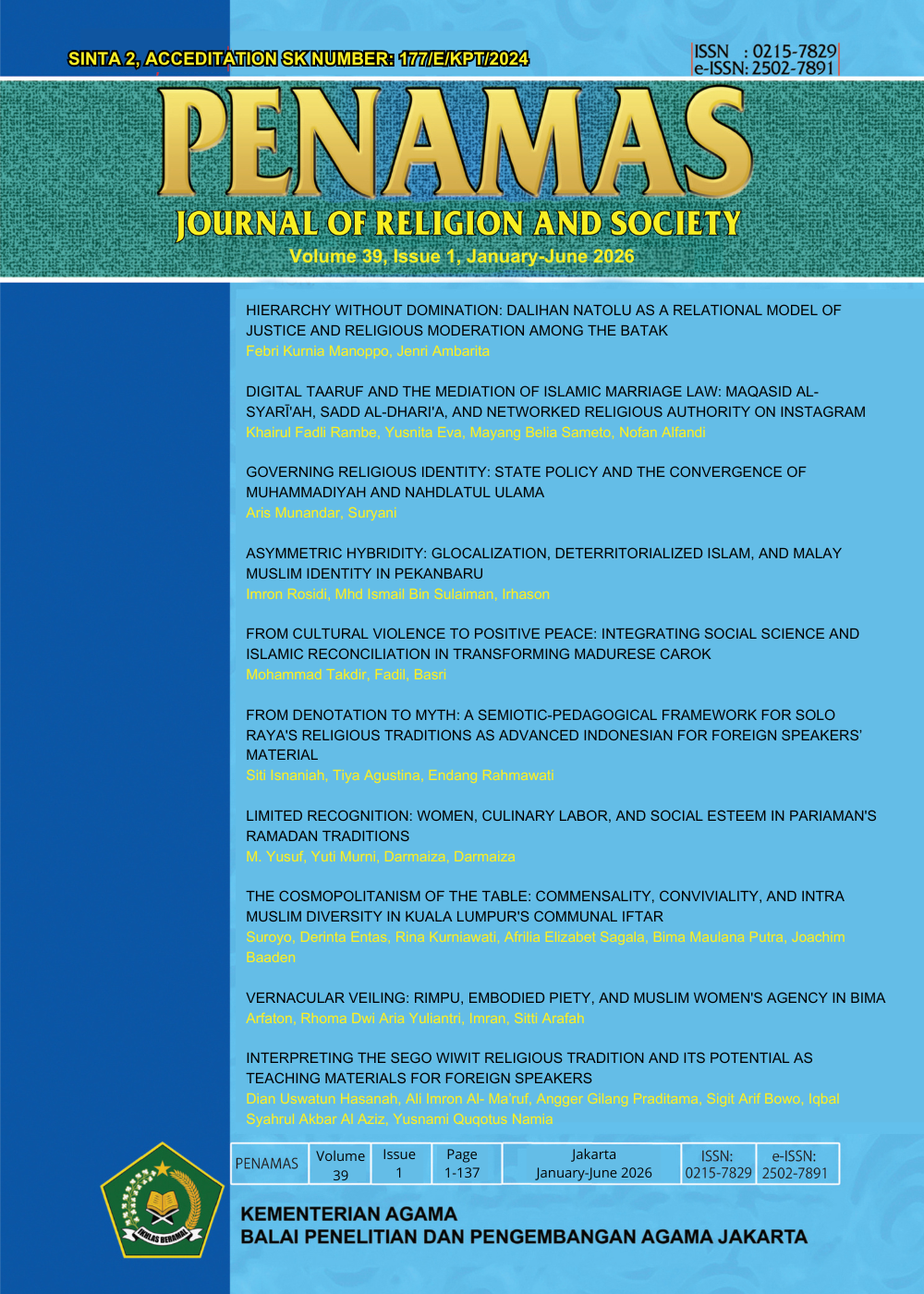
Limited Recognition: Women, Culinary Labor, and Social Esteem in Pariaman's Ramadan Traditions
DOI:
https://doi.org/10.31330/penamas.v39i1.1080Keywords:
Maanta Pabukoan, Malamang, Social Recognition, Limited Recognition, Symbolic CapitalAbstract
Penelitian ini mengkaji dua tradisi Ramadan di Pariaman—maanta pabukoan dan malamang—sebagai arena pengakuan sosial bagi perempuan dalam masyarakat matrilineal yang religius. Berbeda dari kajian terdahulu yang menyoroti kohesi sosial atau otoritas perempuan Minangkabau lewat harta pusaka dan garis keturunan. Penelitian ini menelaah bagaimana praktik keagamaan-kuliner sehari-hari mendistribusikan penghargaan bagi perempuan, serta apakah penghargaan tersebut sejalan atau berbeda dengan kedudukan matrilineal mereka. Penelitian yang menggunakan metode kualitatif ini menghimpun data melalui wawancara, observasi, dan dokumentasi. Secara analitis, penelitian ini menggabungkan teori pengakuan Axel Honneth (ranah penghargaan sosial) dengan konsep modal simbolik Pierre Bourdieu. Temuan menunjukkan kedua tradisi merupakan arena distribusi pengakuan: perempuan memperoleh legitimasi sosial melalui keahlian kuliner, kompetensi domestik, dan perannya menjaga solidaritas keluarga serta kohesi komunitas Ramadan. Penelitian ini mengusulkan konsep "pengakuan terbatas"—legitimasi nyata di ruang publik, namun bersyarat pada performa gender normatif dan diraih lewat dapur, bukan diberikan tanpa syarat. Dengan demikian, kedudukan perempuan Minangkabau sekaligus diberdayakan oleh adat dan dibatasi oleh ekspektasi gender keagamaan.
References
Abdurrahman. (2023). Tradisi Beppa Apang di Bulan Ramadhan: Studi Komparatif Antara Nilai Qur’ani dan Perkara Bid’ah. Pappasang, 5(1). https://jurnal.stainmajene.ac.id/index.php/pappasang/article/view/540%0Ahttps://jurnal.stainmajene.ac.id/index.php/pappasang/article/download/540/315
Ajayi, C. E., Chantler, K., & Radford, L. (2022). The Role of Cultural Beliefs , Norms , and Practices in Nigerian Women ’ s Experiences of Sexual Abuse and Violence. Violence Against Women, 28(2), 465–486. https://doi.org/10.1177/10778012211000134
Alaeddine, C., Schreiber, J., & Amin, M. E. K. (2024). Ramadan fasting intentions among pregnant women in Lebanon. Journal of the Egyptian Public Health Association, 99(1), 1. https://doi.org/10.1186/s42506-023-00148-2
Bakry, M., Syatar, A., Ramli, A. R., & Minasyan, S. (2025). Empowering Women in Islamic Rituals : A Participatory Approach to Barzanji Recitations in Bugis Pesantren. Al-Maiyyah: Media Transformasi Gender dalam Paradigama Sosial Keagamaan, 1(1), 37–48. https://doi.org/10.35905/almaiyyah.v18i1.13098
Bakti, I. S., & Situmorang, N. (2024). Konsumsi, Arena Perjuangan Kelas, dan Dominasi Budaya: Tinjauan Atas Pemikiran Pierre Bourdieu. Journal of Political Sphere (JPS), 5(2), 113–125. https://doi.org/10.24815/jps.v5i2.43316
Basumatary, J. (2024). Gendered Heritage: A Study of Bodo Women’s Role in Preserving Cultural Traditions. ShodhKosh: Journal of Visual and Performing Arts, 5, 2003–2008. https://doi.org/10.29121/shodhkosh.v5.i1.2024.477
Basumatary, P. (2022). Bodo Women as Bearers of Intangible Cultural Heritage. Asian Ethnology Review, 19(4), 88–103.
Bourdieu, P. (1986). The Forms of Capital. In Handbook of Theory and Research for the Sociology of Education (1986),. CT: Greenwood.
Bourdieu, P. (1994). The Field of Cultural Production. Columbia University Press.
Bourdieu, P. (2010). Arena Produksi Kultural: Sebuah Kajian Sosiologi Budaya (I. R. Muzir (ed.); Terjemahan). Kreasi Wacana.
Buckley, A., & Carland, S. (2023). Triple Roles , Worship , and “ Period Shaming ”: How Muslim Women Maintain Belonging and. Journal for The Scientifics Study of religion, 62(4), 869–884. https://doi.org/10.1111/jssr.12873
Cantika, S. D., & Rafiqah, W. (2024). Gender and Social Power: Anthropological Analysis of the Role of Women in Traditional Minangkabau Society. Journal of Demography,Etnography,and Social Transformation e-ISSN:, 4(2), 94–105.
Capitani, E., & Rinaldini, M. (2024). Axel Honneth and Digital Alienation New Perspectives on Social Theory between Labor Process, Sociology and Social Philosophy. 5th World Conference on Arts, Humanities, Social Sciences and Education.
Creswell, J. W. (2013). Qualitative Inquiry and Research Design: Choosing Among Five Approaches. Sage Publications.
Darmawati. (2023). Penjualan Fshion di Bulan Ramadan. In Ramadan dan Geliat Ekonomi. Az-Zahra Media Society.
Das, M. (2025). Food and Rituals : Narratives of Food Consumed by Assamese Menstruating Women. International Journal of Research and Review, 12(January), 279–287.
Demidova, M. V. (2024). Symbolic capital: Interpretations and types. Philosophy and Conflict Studies, 40(3), 392–403.
Devi, M. (2020). Menstrual Rituals, Food, and Gender Identity among Assamese Women. South Asian Cultural Studies, 13(3), 101–118.
Edeh, E. (2026). Axel Honneth: Recognition and Self-Resfect. Journal of Philosophy and Contemporary Issues, 2(1), 106–115.
Fauziyah, E., Yarno, & Hermoyo, R. P. (2021). Simbol Pada Tradisi Megengan Di Desa Kedungrejo, Waru, Sidoarjo (Kajian Semiotika Roland Barthes). Prosiding Samasta, 232–239.
Fu, J. (2024). Gender , Islam , and Religiosity : Working Malay Women ’ s Agency in Navigating Gender Relations and Subjectivity By Jingyi Fu (Nomor August). The University of Chicago.
Fuller, C., & Gassner, G. (2026). Recognition theory , political agency and intersubjective institutions : The case of contesting austerity. EPC: Politics and Space, 0(0), 1–17. https://doi.org/10.1177/23996544261459820
HettiI, M. P. C. (2026). Education and Axel Honneth’s theory of recognition. Revista Brasileira de Educação, 31, 1–17. https://doi.org/https://doi.org/10.1590/S1413- 24782026310004
Honneth, A. (2012). Recognition Theory as Social Research: Investigating the Dynamics of Social Conflic (S. O’Neill & N. H. Smith (ed.)). Palgrave Macmillan.
Hrytsenko, O. (2021). Post-Liturgical Female Rituals among Ukrainian Migrant Women in Israel. Gender and Religion Review, 17(1), 55–72.
Husna, L., & Wahyuni, E. S. (2024). The cultural attachment of matrilineal traditions with gender roles in Minang migrant households. Jurnal Sains Komunikasi dan Pengembangan Masyarakat, 08(3), 40–54.
Hussain, S., Ahsan, S., Ali, A., Khan, H., Tibi, S., & Mohsin, H. (2026). Exploring the impact of Ramadan fasting on women ’ s reproductive health : A narrative review. Women’s Health, 22, 1–12. https://doi.org/10.1177/17455057261435746
Islam, A. H. M. Y. (2026). The Importance of the Lessons of Ramadan for Ensuring Peace and Purity in Human Society. IJRISS: International Journal of Research and Innovation in Social Science, X(2454), 1502–1508. https://doi.org/10.47772/IJRISS
Iswaratama, A. (2024). Makna Tradisi Bulan Ramadhan Di Kehidupan Masyarakat Lombok NTB. AL-AFKAR: Journal for Islamic Studies, 7(2), 763–772. https://doi.org/10.31943/afkarjournal.v7i2.1009.The
Jha, A. (2024). Women As Custodians Of Folk Art Traditions In India : Gendered Narratives And Cultural Continuities In Context To Madhubani Art. . . ShodhKosh: Journal of Visual and Performing Arts, 5, 1669–1675. https://doi.org/10.29121/shodhkosh.v5.i7.2024.627
Jike, L. (2025). Cosmology , Gender , and Rituals : An Analysis of the Nuosu Shalaluo Ceremony. International Journal of Asian Social Science Research, 2(1), 29–33.
Jubba, H., Rustan, A. S., & Juhansar, J. (2018). Kompromi Islam dan Adat pada Praktik Keagamaan Muslim Bugis di Sulawesi Selatan. JSW (Jurnal Sosiologi Walisongo), 2(2), 137–148. https://doi.org/10.21580/jsw.2018.2.2.2865
Kabes, Y. P. P. (2025). Joom Jak Sasi : The Role of Women in Traditional Coastal Management in Aduwei Raja Ampat. Analisa: Journal of Social Science and Religion, 10(December), 180–198.
Kata Data Insight Center. (2020). Perilaku Konsumen E-Commerce Indonesia.
Knieriem, M. (2024). The limits of recognition The limits of recognition. Inquiry, 3923, 1–36. https://doi.org/10.1080/0020174X.2024.2338822
Kretz, D. (2021). Recognition for Good Europeans : On Axel Honneth ’ s Recognition. international journal for history, culture and modernity, 9, 29–39. https://doi.org/10.1163/22130624-20220005
Leeuwen, B. Van. (2007). A Formal Recognition of Social Attachments : Expanding Axel Honneth’s Theory of Recognition. Inquiry, 50(2), 180–205. https://doi.org/10.1080/00201740701239897
Lin, B.-W., & Chen, C.-J. (2006). Fostering product innovation in industry networks: The mediating role of knowledge integration. International Journal of Human Resource Management, 17(1), 155–173. https://doi.org/10.1016/j.cam.2005.08.016
Locock, L., Snow, A. B. R., & Staniszewska, S. (2017). The power of symbolic capital in patient and public involvement in health research. Health Expect, 20:(October 2016), 836–844. https://doi.org/10.1111/hex.12519
Makmun, S. (2016). The Fasting of Ramadan: Forming Positive Personal Character. Humaniora, 7(3), 405. https://doi.org/10.21512/humaniora.v7i3.3594
Malik, A., Rahman, A., Ummah, A. H., Perwira, R., & Erlandy, T. D. (2025). Symbolic Communication in The Bettulak Ritual : Harmony Between Local Beliefs and Epidemic Prevention Strategies In Lendang Ara Village. Penamas: Religion And Socety Research Journal, 38(2), 235–249.
Mappaware, N., Syahril, E., Royani, I., Bamahry, A., Safitri, A., Nurmadila, N., Hamsah, M., & Nulanda, M. (2020). Puasa pada Wanita Hamil dan Menyusui. UMI Medical Journal, 5(1), 38–49. https://doi.org/10.33096/umj.v5i1.88
Meitikasari, D., & Drianus, O. (2021). Rekognisi Axel Honneth: Gramatika Moral Bagi Defisit Rasionalitas Beragama. JAQFI: Jurnal Aqidah dan Filsafat Islam, 6(1), 24–47.
Miswardi, M., Basir, G., Rosman, E., Elfiani, E., & Tarihoran, A. S. (2024). Gender Dynamics in Minangkabau Customs : Women ’ s Role in Safeguarding and Preserving High Heirlooms. HUMANISMA: Journal of Gender Studies, 8(2), 165–179.
Munir, M. (2016). Sistem Kekerabatan Dalam Kebudayaan Minangkabau: Perspektif Aliran Filsafat Strukturalisme Jean Claude Levi-Strauss. Jurnal Filsafat, 25(1), 1. https://doi.org/10.22146/jf.12612
Muzani, S. (2014). Gender Dalam Perspektif Syariah Islamiyah. Jurnal SAWWA, 10(1), 47–58.
Noordegraaf, M., & Schinkel, W. (2011). Professionalism as Symbolic Capital: Materials for a Bourdieusian Theory of Professionalism. Comparative Sociology, 10(1). https://doi.org/https://doi.org/10.1163/156913310X514083
Nurdin, A. (2020). Matrilineal Heritage and Women’s Custodianship in Minangkabau Society. Indonesian Journal of Social Anthropology, 14(3), 201–219.
Osim, S. E., & Eteng, N. G. (2021). Women and Ritual Purity in Islam. Indonesian Journal of Social and Educational Studies, 2(1), 117–127.
Panda, T., Mishra, N., Ray, A., Rahimuddin, S., & Kumar, B. (2025). Women ’ s Ritual Art and Intergenerational Knowledge : A Visual Ethnography of Jhuti Practices in Bhadrak District , Odisha. Journal of Contemporary Rituals and Traditions, 3(2), 117–132. https://doi.org/10.15575/jcrt.735
Petherbridge, D. (2021). Recognition , Vulnerability and Trust Recognition , Vulnerability and Trust. International Journal of Philosophical Studies, 29(1), 1–23. https://doi.org/10.1080/09672559.2021.1885135
Pilapil, R. D. (2026). Struggling over recognition : Honneth , political resistance , and violence. Front. Sociol., 10(January), 1–10. https://doi.org/10.3389/fsoc.2025.1693721
Piroddi, C. (2021). Hope , habitus and social recognition : A Bourdieusian proposal. Journal for the Theory of Social Behaviour, September, 1–17. https://doi.org/10.1111/jtsb.12325
Porter, L., & Barry, J. (2014). Bounded recognition: urban planning and the textual mediation of Indigenous rights in Canada and Australia. Critical Policy Studies, 22–40. https://doi.org/10.1080/19460171.2014.912960
Prashizky, A. (2026). Post-Liturgical Women ’ s Rituals Among Western Ukrainian Female Labor Migrants in Israel. Religions, 17(396).
Rafi, I. (2018). Golongan yang Mendapatkan Rukhṣah dalam Ibadah Puasa dan Konsekuensi Hukumnya. Nukhbatul ’Ulum, 4(2), 150–172. https://doi.org/10.36701/nukhbah.v4i2.47
Royanulloh, R., & Komari, K. (2019). Bulan Ramadan dan Kebahagiaan Seorang Muslim. Jurnal Psikologi Islam dan Budaya, 2(2), 51–62. https://doi.org/10.15575/jpib.v2i2.5587
Saidung, M. I., Muhammad, R., & Salsabila, F. (2025). Identity and Local Religious Tradition of The Al-Mandari Community: A Study of Tarekat The Annangguru Sayye ’ Daengna Ma ’ Rufi Al -Manda. Penamas: Religion And Socety Research Journal, 38(2), 220–234. https://doi.org/https://doi.org/10.31330/penamas. v38i2.1008
Salman, S. (2024). Respect and Struggles for Recognition : Kant and Honneth. Con-Textos Kantianos, 20, 31–40. https://doi.org/https://doi.org/10.5209/kant.95647
Sasnitya, R., Kurniawan, E., Supriadi, R., & Qodri, A. N. (2025). Exploring the Meaning of Ramadan from the Perspectives of Islam in America and Indonesia : A Corpus-Based Analysis. Tafkir: Interdisciplinary Journal of Islamic Education, 6(3), 619–636.
Semenova, T., & Egorova, O. (2024). The Role of Women in Traditional Calendar Festivals And Rituals of The Chuvash. Vestnik Chuvashskogo universiteta.
Setiyawan, D., Wahyuningsih, S. E., Hafidz, J., & Mashdurohatun, A. (2024). Syariah Exploring Abhakalan Culture (Early Marriage) in Madura : A Dialogue of Customary Law , Religion , and The State. Ahkam: Jurnal Ilmu Syariah, 24(2), 345–364.
Shalihin, N., & Sholihin, M. (2022). Ramadan: the month of fasting for muslim and social cohesion—mapping the unexplored effect. Heliyon, 8(10), e10977. https://doi.org/10.1016/j.heliyon.2022.e10977
Shalihin, N., Yulia, & Sholihin, M. (2021). The Other Side of Ramadan: Ramadan and Its Implication on Social Cohesion In West Sumatra and Yogyakarta. Analisa; Journal of Social Science and Religion, 6(1), 79–94. https://doi.org/10.18784/analisa.v6i01.1309
Shalihin, N., Yusuf, M., & Hulwati, H. (2023). Social Cohesivity of The Indonesian Muslim Community During the Ramadan. Islam Realitas: Journal of Islamic and Social Studies, 9(1), 12. https://doi.org/10.30983/islam_realitas.v9i1.6169
Singh, N. (2025). Echoes of Silence : Tradition and transgressions in folk songs of mithila. International Journal of History 2025;, 7(266), 102–110.
Stark, A. (2013). The Matrilineal System of the Minangkabau and its Persistence Throughout History : A Structural Perspective The Minangkabau society. Southeast Asia: A Multidisciplinary Journal, 13, 1–13.
Suryani A., E. . N. (2023). Women’s Role in the Ngasa Gandoang Mountain Alms Ritual in Central Java. Journal of Cultural Heritage Studies, 12(2), 45–61.
Syah, M. A., Agustinova, D. E., Arfaton, A., & Rizki, I. A. (2026). Religious and Social Values in The Bajapuik Tradition of Minangkabau Weddings : A Comparative Perspective on Bridewealth. Penamas: Religion And Socety Research Journal, 38(1), 13–24.
Syahrul, N., Sunarti, S., & Syahrial, P. F. L. (2026). Women ’ s Agency in Preserving Ngasa Gandoang Mountain Alms Ritual. Leksema: Jurnal Bahasa dan Sastra, 11(3), 1–16.
Timme, U. (2018). Chronotopic-Narratives-of-Seven-Gurus-and-Eleven-Texts. Cracow Indological Studies, XX(2), 1–25.
Trang, N. M., Doan, T., & Linh, P. (2025). Women ’ s Roles in Food Culture and Traditions in. 9th International Conference on Social Sciences un The 21st Century, 2.
Waryono. (2021). Tradisi dan Makna Filosofi Kuliner Minangkau. Jurnal Pendidikan dan Perhotelan, 1(2).
Yohannes, M. (2022). 12 Tradisi Ramadan Khas dari Berbagai Daerah di Nusantara. Traveloka.Com. https://www.traveloka.com/id-id/explore/destination/tradisi-ramadan-di-indonesia-acc/29616
Yuliyani, D. S. (2022). Mengenal Tradisi Menyambut Bulan ramadan (Studi tentang Tradisi Penggahan dan Pudunan). Sosial Budaya, 19(1).
Downloads
Published
Issue
Section
License
Copyright (c) 2026 Penamas

This work is licensed under a Creative Commons Attribution-NonCommercial-ShareAlike 4.0 International License.