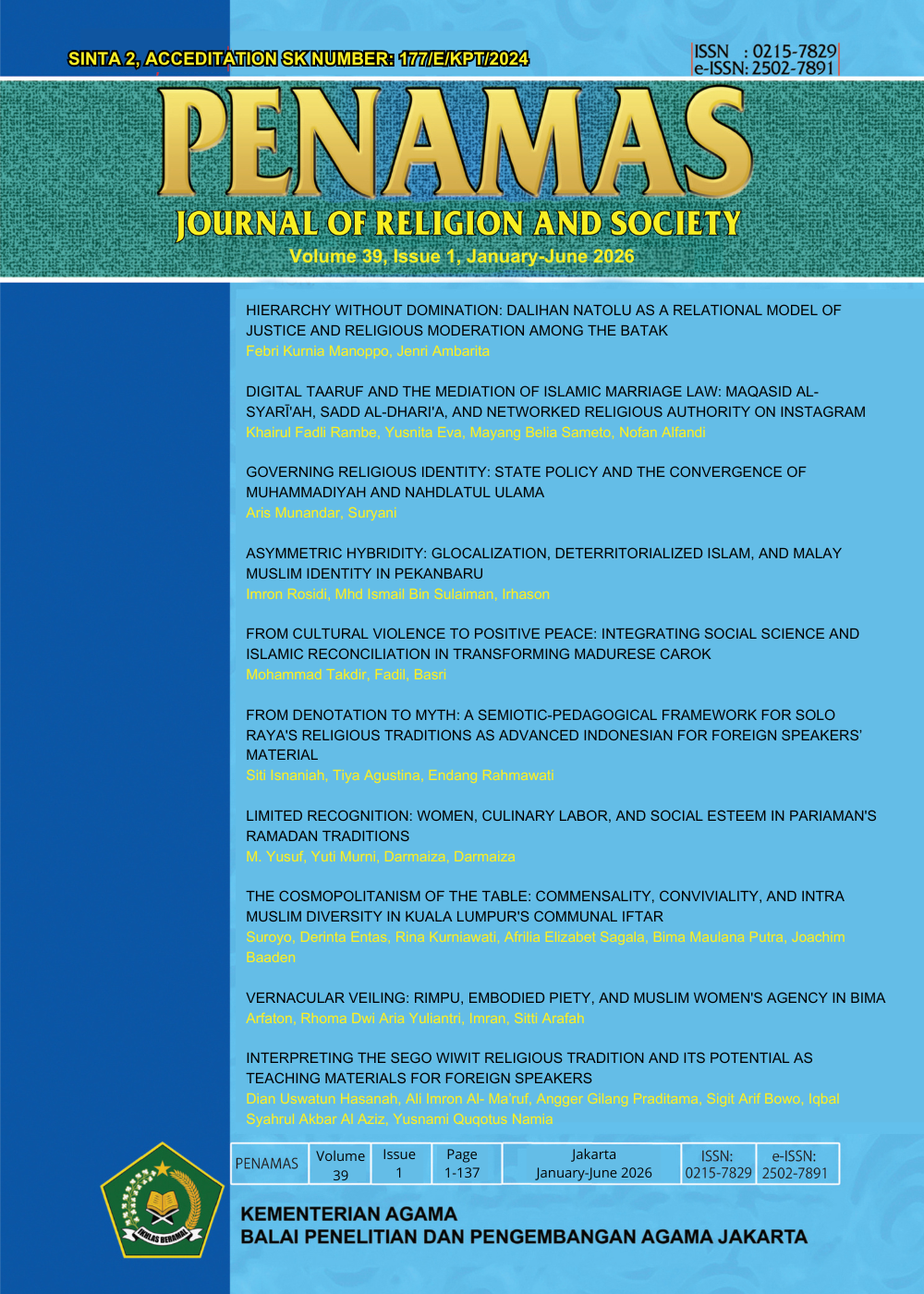
Hierarchy without Domination: Dalihan Natolu as a Relational Model of Justice and Religious Moderation among the Batak
DOI:
https://doi.org/10.31330/penamas.v39i1.1082Keywords:
Dalihan Natolu, religious moderation, Asymmetrical Equality, Reciprocal Justice, Indigenous Social CapitalAbstract
This study examines the paradox of ‘dalihan natolu’, the Batak kinship system: how a hierarchy based on inherited roles produces egalitarian relationships whilst simultaneously underpinning religious moderation. This paradox is difficult to explain through John Rawls’s liberal theory of justice, which is grounded in individualism and the equality of basic freedoms, and thus regards ascriptive hierarchies as the antithesis of justice. Building on Rawls, this study interprets the dalihan natolu through the paradigm of relational justice and the theory of reciprocal exchange, asking: through what mechanisms and within what limits can different roles produce fairness and equality? Data were collected qualitatively through in-depth interviews, participatory observation and audiovisual content analysis. The findings reveal asymmetrical equality: rotating reciprocal obligations counterbalance an advantage in one relationship with a subordinate position in another, preventing hierarchies from solidifying into permanent domination. This mechanism transcends religious divides, whilst leaving gender tensions and the burden of customary obligations unresolved. Dalihan natolu challenges the liberal assumption that ascriptive roles preclude justice, whilst simultaneously promoting inter-religious, kinship-based religious moderation.
References
Abdurrazak, Azhari, S., Wanda, P., Ambakti, L. S., & Humamurrizqi. (2022). Religious Tolerance Based On Local Wisdom: Social Perspective Of Lombok Community. Jurnal Lektur Keagamaan, 20(1). https://doi.org/10.31291/jlka.v20i1.1027
Abubakre, M., Faik, I., & Mkansi, M. (2021). Digital entrepreneurship and indigenous value systems: An Ubuntu perspective. Information Systems Journal, 31(6). https://doi.org/10.1111/isj.12343
Adlit, M. F., & Martinez, M. R. (2023). Reliving the Bayanihan Spirit: SPRCNHS Landayan Annex Narratives in the New Normal. Puissant, 4.
Anderson, E. S. (1999). What is the point of equality? Ethics, 109(2). https://doi.org/10.1086/233897
Apriani, N. W., & Aryani, N. K. (2022). Moderasi Beragama: Moderasi Beragama dalam Geguritan Dharma Sunyata. Kalangwan Jurnal Pendidikan Agama, Bahasa Dan Sastra, 12(1), 34–45.
Bae, Y. K. (2021). Globalization of Hongik Ingan (Devotion to the Welfare of Mankind) Thought. Korean Thought and Culture, 104. https://doi.org/10.31037/ktac.104.2
Chung, C. K., & Cho, S. J. (2006). Conceptualization of jeong and dynamics of hwabyung. In Psychiatry Investigation (Vol. 3, Issue 1).
Djainudin, H. (2022). The conception of religious moderation in interfaith dialogue in Indonesia; Case study in Flores Nusa Tenggara Timur. Humanika, 22(2). https://doi.org/10.21831/hum.v22i2.54304
Dylag, M. (2023). Theorizing Access to Civil Justice. Canadian Journal of Law and Jurisprudence, 36(1). https://doi.org/10.1017/cjlj.2022.29
Efturi. (2024). Batak Cultural Social Media Activist, Live Interview, Interview, November 11.
Faturahman, M., & Izra Berakon. (2025). Local Indonesian Traditions And The Enhancement of Social Spirituality in Rural Communities. Penamas, 38(2). https://doi.org/10.31330/penamas.v38i2.997
Fitri, A., Isjoni, & Bunari. (2023). Penerapan Filosofi Adat Dalihan Natolu dalam Kehidupan Masyarakat Batak Toba di Kecamatan Pinggir Kabupaten Bengkalis. JISHUM : Jurnal Ilmu Sosial Dan Humaniora, 1(3). https://doi.org/10.57248/jishum.v1i3.110
Güner, S., & Sandal, N. A. (2022). The Role of Informational Asymmetry in Interfaith Communication During Conflict: A Game Theoretical Approach. International Journal of Religion, 3(1). https://doi.org/10.33182/ijor.v3i1.1585
Hanan, H. (2012). Modernization and Cultural Transformation: The Expansion of Traditional Batak Toba House in Huta Siallagan. Procedia - Social and Behavioral Sciences, 50. https://doi.org/10.1016/j.sbspro.2012.08.082
Harahap, A. S., Mulyono, H., Nuzul, Milhan, M., & Siregar, T. (2023). Dalihan Na Tolu as a Model for Resolving Religious Conflicts in North Sumatera: An Anthropological and Sociological Perspective. Samarah, 7(3). https://doi.org/10.22373/sjhk.v7i3.13091
Harahap, S. M., & Hamka, H. (2023). Investigating the roles of philosophy, culture, language and Islam in Angkola’s local wisdom of ‘Dalihan Na Tolu.’ HTS Teologiese Studies / Theological Studies, 79(1). https://doi.org/10.4102/hts.v79i1.8164
Huda, M. I., Pasaribu, I. L., & Fitri, A. (2025). Community Paradigm Toward the Naposo Nauli Bulung Tradition at Weddings: a Paradox Between Preserving Tradition and Economic Constraints. Penamas, 38(1). https://doi.org/10.31330/penamas.v38i1.892
Hutahaean, S. (2024). Maranggap tradition in Batak funeral customs (Personal interview).
Kementerian Agama RI. (2019). Moderasi Beragama. Badan Litbang dan Diklat Kementerian Agama RI.
Lim, K. (2022). Exploring the Realization Direction of Korean Reunification Policy based on the Modern Application of Hongik-Ingan Ideas. Barun Academy of History, 10. https://doi.org/10.55793/jkhc.2022.10.119
Martens, K. (2012). Justice in transport as justice in accessibility: Applying Walzer’s “Spheres of Justice” to the transport sector. Transportation, 39(6). https://doi.org/10.1007/s11116-012-9388-7
Martial, T., & Asaad, M. (2016). The land and tree tenure-based Dalihan natolu customs for tree management in South Tapanuli, North Sumatra. International Journal on Advanced Science, Engineering and Information Technology, 6(2). https://doi.org/10.18517/ijaseit.6.2.696
Mugumbate, J. R., Mupedziswa, R., Twikirize, J. M., Mthethwa, E., Desta, A. A., & Oyinlola, O. (2024). Understanding Ubuntu and its contribution to social work education in Africa and other regions of the world. Social Work Education, 43(4). https://doi.org/10.1080/02615479.2023.2168638
Muhammad Ikhsan Saidung, Riza Muhammad, & Salsabila, F. (2025). Identity and Local Religious Tradition Of The Al-Mandari Community: A Study Of Tarekat The Annangguru Sayye’ Daengna Ma’rufi Al-Mandari. Penamas, 38(2). https://doi.org/10.31330/penamas.v38i2.1008
Nasution. (2024). Batak Muslim religious leader, Live Interview, Desember 2.
Park, S. K. (2020). Jeong: A practical theology of postcolonial interfaith relations. Religions, 11(10). https://doi.org/10.3390/rel11100515
Sihombing. (2024). Batak Christian religious leader, Live Interview, Interview Desember 1.
Simatupang, M. S., Peter, R., & Murniarti, E. (2020). The Kinship of “Dalihan Na Tolu” of Batak Culture in Indonesia. PalArch’s Journal of Archaeology of Egypt/Egyptology, 17(4).
Soriano, C. R., Cabalquinto, E. C., & Panaligan, J. H. (2021). Performing “digital labor bayanihan”: strategies of influence and survival in the platform economy. Sociologias, 23(57). https://doi.org/10.1590/15174522-113027
Steen-Johnsen, T. (2020). The rhetoric of love in religious peacebuilding. Journal of Contemporary Religion, 35(3). https://doi.org/10.1080/13537903.2020.1810972
Strauss, C. L. (1969). The Elementary Structures of Kinship (13th ed.). Beacon Press.
Tagalog, B. (2023). Bayanihan. In Beginning Tagalog. https://doi.org/10.2307/jj.7994688.9
Vergouwen, J. C. (1964). The Social Organisation and Customary Law of the Toba-Batak of Northern Sumatra. In The Social Organisation and Customary Law of the Toba-Batak of Northern Sumatra. https://doi.org/10.1007/978-94-015-1035-6
Zaman, M. B., Mawardi, I., & Muna, M. Y. (2024). Local Wisdom For Peacebuilding In Java : An Analysis Of Religious Moderation In Shodiq Hamzah ’ S Tafsīr Al-Bayān. 22(2), 455–482.
Downloads
Published
Issue
Section
License
Copyright (c) 2026 Penamas

This work is licensed under a Creative Commons Attribution-NonCommercial-ShareAlike 4.0 International License.